By Fabian Barcelo, Founder & Veterinary Scientist
Vet-reviewed
By Fabian Barcelo, Founder & Veterinary Scientist
Vet-reviewed
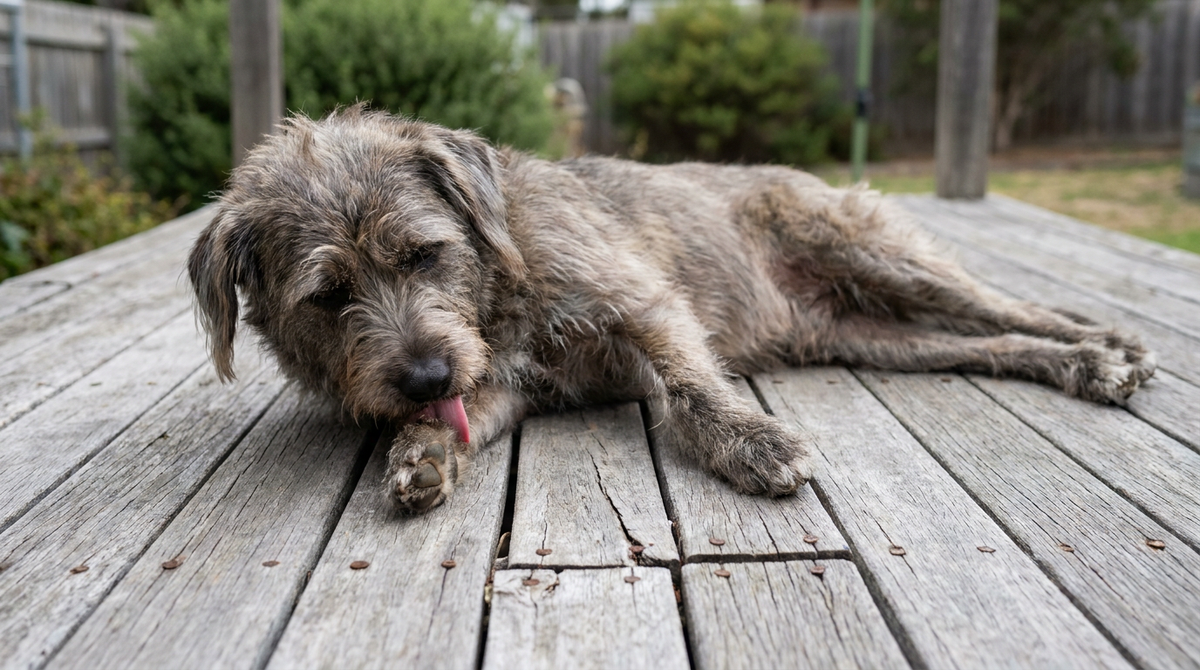
Almost every dog licks its paws. It is ordinary self-grooming, and a few seconds of attention after a muddy walk means nothing. What brings people to their vet, and to us, is the other version: the dog that works at one paw for twenty minutes straight, or the wet slurping that starts on the rug at nine o'clock every night. At InnoVet we make pet supplements, so it is worth saying up front that paw licking is a symptom rather than a diagnosis, and that most of what causes it is not nutritional.
Key takeaways
- Brief grooming is normal. Licking that is persistent, or that has changed in character, is a signal worth investigating.
- Which paws matters. All four, usually with itchy ears and belly, points towards allergic skin disease. One paw, suddenly, points towards something physical.
- Rusty brown staining on white fur is dried saliva, not dirt. It tells you this has been going on for weeks, not days.
- Grass seeds are a real and time-sensitive Australian problem through spring and summer. They need a vet, not a wash.
- Anxiety is a real cause, but it belongs at the end of the list, after the physical causes have been ruled out by a vet.
01Where normal grooming ends
There is no stopwatch that separates healthy grooming from a problem, but there are patterns reliable enough to act on. A dog that gives its feet a quick going over after a walk and then settles is behaving normally. A dog that returns to the same spot repeatedly, that interrupts sleep to lick, or that has started doing something it did not do three months ago, is telling you something has changed.
Before booking an appointment, watch properly for a few days and write it down. Which paw or paws. What time of day. Whether the skin between the toes is pink and puffy. Whether the ears are being scratched too. That short list will shape the consultation far more than a general report that the dog licks a lot.
Usually ordinary
- A brief clean after a walk, then the dog moves on
- Skin between the toes looks the same as it always has
- No smell, no staining, no swelling
- Happy to stop when you interrupt and redirect
Worth investigating
- Long sessions, or licking that wakes the dog at night
- Red, thickened or moist skin in the webbing
- Brown saliva staining, an odour, or hair loss
- The dog objects when you handle the foot
02Allergic skin disease, the most common explanation
If you ask a vet why is my dog licking his paws, allergy is the answer they reach for most often, and usually environmental allergy rather than food. Atopic dermatitis is a lifelong tendency for the skin to overreact to everyday things such as grass and weed pollens, dust mites and mould spores. Paws are involved so often because they are in constant contact with the ground, and because they are the easiest itchy place to reach.
The pattern is the giveaway. Allergic dogs typically lick all four paws rather than one, and the itch rarely stays in the feet. Look for ear scratching or recurring ear infections, a pink belly and armpits, face rubbing and a dog that seems restless in the evening. Environmental allergy is often seasonal, flaring reliably in spring and summer, which we cover in our piece on itchy skin and seasonal allergies in dogs. Food allergy is less common and tends to run year round.
This is a veterinary diagnosis, not one you can make from a website. Working out whether a dog is atopic takes a proper examination, ruling out parasites and infection, and often an elimination diet supervised by your vet. Allergic skin disease is managed rather than resolved, and the aim is comfort over the long term.
03Yeast and bacteria, and why the cycle keeps itself going
This is the part people miss. Whatever started the licking, saliva keeps the webbing between the toes warm and damp, which is ideal for the yeast and bacteria already living on normal skin to multiply beyond their usual numbers. Malassezia yeast and staphylococcal bacteria are the usual suspects. Once they overgrow the skin becomes itchier still, so the dog licks more, which keeps the skin damp, which suits the overgrowth.
You can often smell it before you see it. A yeasty, musty odour, sometimes described as corn chips, is a common report. The other classic sign is rusty brown staining on the fur, a pigment in saliva rather than dirt, which does not scrub off. The skin may be red, greasy or thickened, and in some dogs the constant trauma tips over into a hot spot that develops alarmingly fast.
What began as a symptom becomes its own cause. Breaking that loop almost always needs a vet, not patience.InnoVet
A secondary infection needs to be identified and addressed by your vet, usually after a swab or tape sample to see what is actually growing. Home washing on its own tends to disappoint, because it does nothing about the reason the dog started licking.
04Grass seeds, the one that cannot wait
This one deserves its own heading because it is a genuinely Australian problem and because it is time-sensitive. From roughly October through to the end of summer, the seed heads of barley grass, spear grass and their relatives dry out and detach. The awns are barbed in one direction only, so once one works its way into the webbing between two toes it can only travel further in. It does not fall back out.
The presentation is distinctive. It is sudden, it is usually one paw, and the dog is frantic about it rather than idly grooming. Often there is a firm swelling about the size of a pea between the toes, sometimes with a small weeping hole at the top of it. The dog may limp or hold the foot up. A migrating grass seed can travel under the skin and cause problems well away from where it went in, which is why this is not something to watch for a week.
If you see that pattern, book a vet appointment promptly, the same day if there is swelling or lameness. The practical habit is simple: after any walk through dry grass, run your fingers between every toe, check the armpits and ears, and keep the hair between the pads of long-coated dogs trimmed short over summer.
One paw, sudden
Think physical. A grass seed, a cut pad, a broken nail, a sting or something lodged in the webbing.
All four, gradual
Think allergic skin disease, particularly if the ears and belly are itchy too and it flares seasonally.
Same paw, older dog
Think pain. Dogs will lick over an arthritic joint, so the sore elbow or wrist may be above the paw being licked.
Brown, smelly webbing
Think secondary infection on top of whatever started it. This one needs a vet either way.
05Irritants underfoot
Paws collect whatever the dog walks on. Fresh lawn fertiliser, weed spray and some garden products can irritate skin on contact, and the simplest response is to rinse the feet with plain water and dry them properly after walks through treated parks or nature strips. Hot pavement matters too, because an Australian footpath in February can be hot enough to scald pads in seconds. Press the back of your hand to the concrete for seven seconds. If you cannot hold it there, the dog should not be walking on it.
Beach dogs get sand between the toes and salt drying on the skin, both easily dealt with by a fresh water rinse at home. In winter the opposite problem appears, with dry indoor air leaving some dogs flaky and uncomfortable, which we cover in our article on dry, flaky skin and dandruff. None of these alone usually cause weeks of licking, but they can start something that infection then sustains.
06Pain that shows up in the paw
This cause is underrecognised and it changes the whole picture when it applies. Dogs will lick over a painful area, and the licking is not always directly above the problem. An arthritic elbow or wrist can present as a dog quietly licking the paw on that limb, with no skin abnormality there at all. It is one reason a vet will watch an older dog walk rather than only look at the foot.
Look for the accompanying signs. Stiffness on rising after a nap, slowing down on walks, hesitating at the car or the back step, or licking concentrated on the same side. There are local causes of paw pain too, including a torn nail, a cracked pad and an interdigital cyst, all found on examination rather than by guesswork.
07Parasites
Fleas remain a common cause of itching, and a flea-allergic dog can be miserable from very few, so finding none on the coat does not rule it out. Mites matter too. Demodex and sarcoptic mange can both involve the feet, and sarcoptic mange is intensely itchy and often affects ear margins and elbows as well. Diagnosis usually means a skin scraping at the clinic, and your vet can advise on the parasite control your dog should be on year round.
08Anxiety and compulsive licking, and why it comes last
Behavioural causes are real. Some dogs lick out of boredom or as a self-soothing habit, some in response to separation distress or a change at home, and in a smaller number the habit becomes compulsive and produces a thickened, hairless patch known as an acral lick granuloma.
This section sits at the bottom of the article because it should sit at the bottom of the diagnostic list. Anxiety is a diagnosis of exclusion, reached after the physical causes have been ruled out. A dog that is itchy or sore also looks restless, and it is easy to read that as nerves. Assuming a behavioural cause first is the most common way a grass seed or a chronic infection goes unaddressed for months.
Where the behavioural element is genuine, the answer is usually more structured exercise and enrichment, a predictable routine, and in some cases referral to a veterinary behaviourist. Your vet is still the right starting point.
See your vet promptly if
- The licking came on suddenly and is focused on one paw
- There is swelling between the toes, or a weeping hole or lump
- Your dog is limping or will not bear weight properly
- There is bleeding, raw skin, or a patch that has lost its hair
- You can smell a foul or yeasty odour from the foot
- The licking has changed in character, intensity or location
09Where nutrition honestly fits
We would rather be straight with you than useful to ourselves here. A supplement will not remove a grass seed, clear an infection or settle a painful joint. If your dog is licking a paw today, nutrition is not the first move, and treating it as one delays the thing that actually needs doing.
Its place is narrower and slower. For dogs with a diagnosed allergic skin condition, the skin barrier is part of the long game, and marine omega-3 fatty acids have been studied as an adjunct for skin and coat condition alongside a veterinary plan rather than instead of one. We explain the detail, including why source and dose matter more than the word on the tub, in our guide to omega-3 and fish oil for dogs and cats and our overview of skin and coat supplements in Australia.
If your vet agrees it fits
Give nutrition eight to twelve weeks
Coat and skin turn over slowly, so a fortnight tells you nothing either way. Note two or three concrete observations before you start, such as how the webbing looks in daylight and roughly how many licking sessions you count in an evening, and compare those at the end instead of relying on impression.
Please speak to your vet before adding anything new, particularly if your dog is on medication, has a diagnosed health condition or is pregnant. Nutritional support is not a substitute for veterinary diagnosis, and a dog that is in pain or has broken skin needs an appointment rather than a new product.
If you want to think about the category properly before spending anything, our Australian guide to dog supplements walks through how to read a label and what to ignore. And if the honest answer for your dog is that this is a veterinary problem with no nutritional shortcut, that is a good outcome too.
Frequently asked questions
Why is my dog licking his paws?
Paw licking is a symptom with many possible causes. The most common is allergic skin disease, usually affecting all four paws along with itchy ears and belly. Other causes include a secondary yeast or bacterial infection, a grass seed lodged between the toes, contact irritants, pain referred from a joint, parasites, and in a smaller number of dogs, anxiety. Your vet is the right person to work out which applies.
Why is my dog licking only one paw?
Licking concentrated on a single paw, particularly if it started suddenly, points towards something physical rather than a general skin condition. A grass seed, a cut pad, a torn nail, a sting or a foreign body are all possibilities, as is pain from a joint higher up the same limb. This pattern is worth a prompt veterinary appointment rather than a wait and see approach.
What does brown staining between my dog's toes mean?
The rusty brown colour is a pigment in saliva, so it is a record of how much licking has been happening rather than dirt that will scrub off. It usually means the behaviour has been going on for weeks. Combined with a yeasty odour, redness or moist skin in the webbing, it suggests a secondary infection that your vet should assess.
Are grass seeds really that serious?
Yes, and they are a common problem in Australia through spring and summer. The awns are barbed so they only travel inwards, and one can migrate under the skin and cause trouble some distance from where it entered. Sudden licking of one paw, a pea sized swelling or a small weeping hole are the typical signs, and they warrant a prompt vet visit rather than home treatment.
How do I get my dog to stop licking its paws?
The licking stops when the reason for it is addressed, so the useful step is a diagnosis rather than a deterrent. Before the appointment, note which paws are involved, when it happens and what the skin looks like. Rinsing and drying paws after walks is sensible general care, but a collar or a bitter spray on its own only hides a problem your vet still needs to find.
Can food allergies cause paw licking?
They can, though environmental allergies are considerably more common. Food related itching tends to run through the year rather than flaring seasonally, and sometimes comes with digestive signs. Confirming it means a properly structured elimination diet supervised by your vet, because over the counter allergy tests and guesswork diet changes are unreliable.
Do supplements help with paw licking?
Not directly, and we would rather say so. A supplement will not remove a grass seed, clear an infection or settle a sore joint. For a dog with a diagnosed allergic skin condition, marine omega-3 and skin barrier support may be a reasonable adjunct alongside the plan your vet has set, given eight to twelve weeks. It is a supporting role, not the answer.

Skin barrier support, alongside your vet's plan
Skin & Coat+ states every active in milligrams per serve and doses by body weight, so you can see exactly what your dog is getting. Human-grade, made in Australia.
Shop Skin & Coat+Human-grade · Australian-made