By Fabian Barcelo, Founder & Veterinary ScientistVet-reviewed
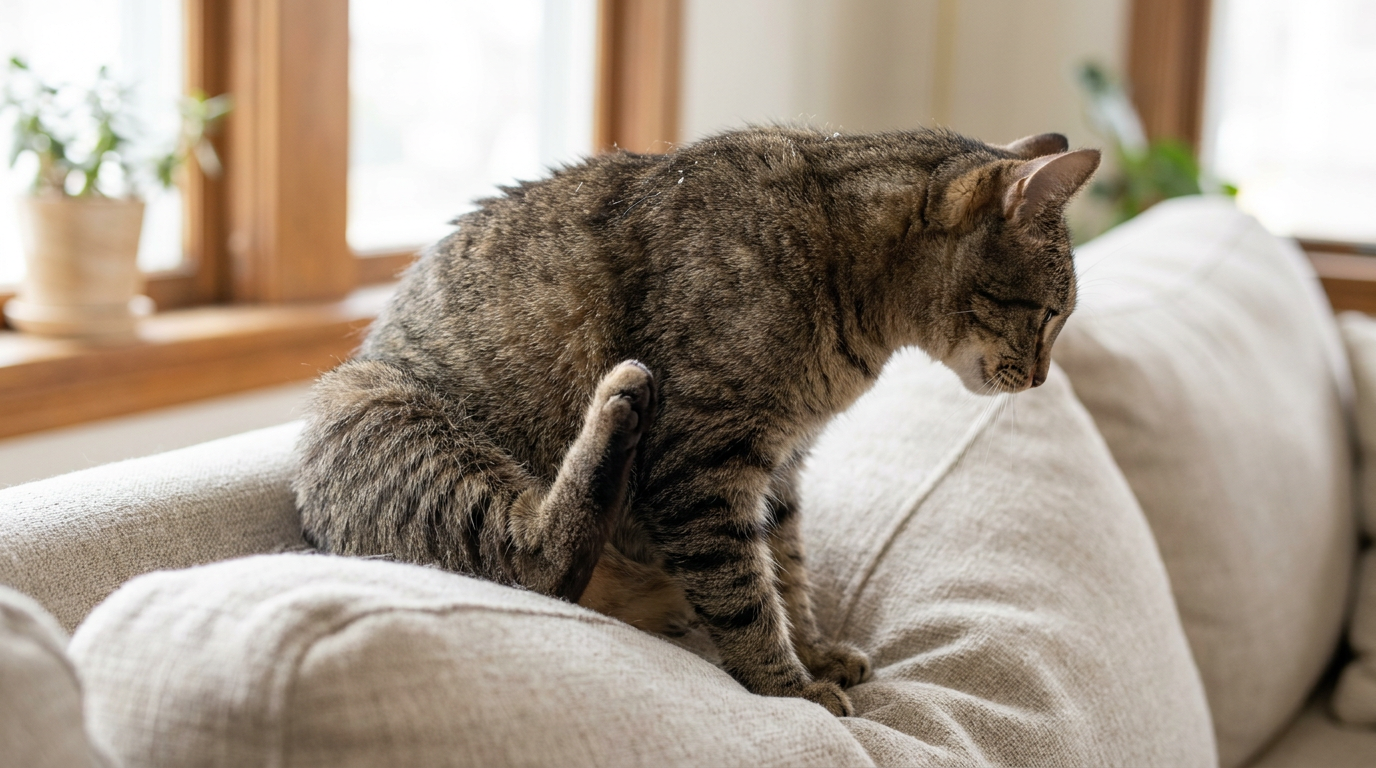
Cats are extraordinarily good at hiding discomfort. A dog with sore joints limps, lags on the walk and makes the problem obvious. A cat simply stops doing the things that hurt. It takes the low road onto the couch instead of springing to the windowsill, it grooms a little less thoroughly along the spine, and it sleeps in a new spot on the floor rather than up high. Nothing looks broken, so nothing gets raised at the vet. That is why feline joint decline is so often caught late, and why choosing a joint supplement for a cat deserves more thought than simply halving a dog product.
Key takeaways
- Cats signal joint discomfort through changed behaviour, not limping. Reduced jumping, a lower landing spot and patchy grooming are the earliest clues.
- Judge a product on actives per serve by weight, not on the ingredient list. A cat at 4 to 5 kg needs a genuine dose scaled to that bodyweight, not a token sprinkle.
- Acceptance beats potency. The best formula is the one your cat will actually eat every day, which usually means a palatable powder mixed through wet food.
01Why cats hide joint pain so well
Joint change in cats is common and quiet. Radiographic surveys of older cats have repeatedly found signs of degenerative joint change in the large majority of cats past about twelve years of age, often in animals whose owners had reported no lameness at all. The mismatch is the whole problem: the joint is changing, the cat is compensating, and the owner sees a cat who is simply getting older and slowing down.
At Innovet, we think the most useful thing an owner can do is stop looking for a limp and start watching for edits to behaviour. Cats edit their world when something hurts. They pick a lower perch. They hesitate for a half-second before jumping. They use the stairs differently, or start missing the litter tray edge because stepping in has become awkward. None of that is dramatic, and all of it is informative.
The number worth knowing
Around 90% of cats over twelve show radiographic signs of degenerative joint change
Yet only a fraction are ever presented to a vet for stiffness, because cats rarely limp. Screening on behaviour, not gait, is what closes that gap.
02The actives that earn their place
Most feline joint products draw on the same short list of ingredients. The differences that matter are dose, form and whether the amount per serve is disclosed at all. These are the four we would look for on a label, and why.
Glucosamine
A building block of cartilage and joint fluid. Look for a stated milligram amount per serve, scaled to a cat's bodyweight rather than borrowed from a dog dose.
Chondroitin
Works alongside glucosamine and is usually paired with it. The ratio matters less than both being present at a disclosed, meaningful level.
Green-lipped mussel
A whole-food source that supplies marine omega-3s alongside naturally occurring glycosaminoglycans. Well suited to cats because it is genuinely palatable.
Omega-3 (EPA and DHA)
Marine omega-3s support the body's normal inflammatory balance. Plant sources such as flaxseed convert poorly in cats, so marine origin matters here.
If you want the longer version of how these ingredients are studied and where the evidence is strongest, our guide to glucosamine and chondroitin goes through it properly.
03Dose by weight is the whole game
This is where most feline joint products quietly fail. A 4.5 kg cat is roughly a tenth of the bodyweight of a 45 kg dog, and a serve that is generous for a cat can be almost invisible on a label that was designed around dogs. Two products can list identical ingredients and deliver wildly different amounts of them.
The practical test is simple. Can you read the label and work out, in milligrams, how much of each active your cat gets in a day? If the answer is no, because the pack lists a proprietary blend or an ingredient order with no quantities, you cannot compare that product to anything else and you cannot tell whether it is working or whether you have simply spent money. Transparent dosing is not a marketing nicety. It is the only thing that makes pet supplements comparable.
No guesswork. Key actives are clearly listed per serve, by weight, so you can compare options and choose confidently.The Innovet standard
04Formats cats will actually accept
A perfectly formulated supplement your cat refuses is worth nothing. Cats are neophobic about food in a way dogs are not, and they detect texture changes readily. In practice this rules a lot of options out.
What tends to work
- A fine powder stirred thoroughly through wet food, so there is no separate texture to detect
- Starting at a quarter dose and building up over a week or two
- A soft, palatable treat format for cats who will not tolerate anything added to the bowl
- Keeping the routine identical each day, same bowl, same time
What to be wary of
- Proprietary blends with no milligram amounts disclosed
- Dog tablets split by hand, which gives an unreliable dose and a bitter mouthful
- Any product promising to cure arthritis or replace veterinary treatment
- Human joint supplements, which can contain sweeteners and dose levels that are not appropriate for cats
05What to expect, and over what timeframe
Joint nutrition is cumulative, not immediate. Give any joint formula a fair trial of at least eight to twelve weeks of consistent daily dosing before you judge it, and decide in advance what you are measuring. Vague impressions are hard to compare; a specific behaviour is not.
Pick two or three concrete markers before you start. Does she get back onto the bed without the intermediate step? Is the fur over the lower back better groomed? Has she started using the top of the scratching post again? Write them down with the date. Reassessing against a written note twelve weeks later is far more honest than trying to remember how she moved in winter.
Nutritional support sits alongside veterinary care, it does not replace it. Sudden lameness, a cat who stops using a limb, obvious pain on handling or a rapid change in behaviour all warrant a prompt veterinary appointment rather than a supplement.
06Where our own formulas fit
We make two products that suit cats with joint support in mind, and we would rather explain the difference than pretend one answer fits every cat.


If your cat is already showing stiffness rather than just slowing down, read our guide to cat joint and arthritis support. For cats over about ten, senior cat joint and mobility support covers the life-stage picture, and the broader joint health guide for dogs and cats is the pillar this sits under. Cat owners weighing up the whole category may also want our complete guide to cat supplements.
Frequently asked questions
Can I give my cat a dog joint supplement?
We would not recommend it. Dog products are dosed for much larger bodyweights, and splitting a tablet by hand gives an unreliable amount. Some dog formulas also include ingredients or flavourings that cats tolerate poorly. Choose a product whose dosing instructions explicitly cover cats and scale by bodyweight.
How long before I see a difference?
Allow eight to twelve weeks of consistent daily dosing. Joint nutrition works cumulatively rather than like a painkiller. Note two or three specific behaviours before you start, such as which surfaces your cat jumps onto, and compare against that written note rather than relying on memory.
What is the earliest sign of joint trouble in a cat?
A change in vertical movement is usually first. Cats stop jumping to the highest perch, choose an intermediate step, or hesitate before launching. Poor grooming over the lower back and hips is another early clue, because twisting to reach that area becomes uncomfortable.
Are joint supplements safe to give alongside veterinary medication?
Often yes, but tell your vet exactly what you are giving and at what dose, because some actives can interact with prescribed treatment. Bring the pack or a photo of the label to the appointment. Your vet is the right person to make that call for your individual cat.
My cat is only six. Is it too early to start?
Not necessarily. Joint change begins long before it becomes visible, and cats who are overweight, who have had a previous injury, or who belong to predisposed breeds may benefit from earlier support. Discuss timing with your vet, who can assess your cat's individual risk.
Joint support your cat will actually eat
Human-grade actives, listed per serve by weight, in a powder that mixes cleanly through wet food.
Shop Joint Health+ →Human-grade · Australian-made