By Fabian Barcelo, Founder & Veterinary Scientist
Vet-reviewed
Training has a reputation problem. It sounds like homework, like something you either have time for or you do not, and like something that belongs in a six-week course rather than in an ordinary Tuesday evening. It is much smaller than that. Most of what people actually want, a dog that does not launch at visitors, a cat that will come out from under the bed for the carrier, a recall that works at the park, is built in two-minute pieces using food you already have. At Innovet, we make treats and pet supplements for dogs and cats, so we spend a lot of time thinking about the reward end of this. Here are five things that make the difference, and none of them require a course.
Key takeaways
- The RSPCA supports reward-based training, where the pet is set up to succeed and then rewarded for the behaviour you want.
- Timing does more work than the treat itself. A reward that lands late teaches something you did not intend.
- Short sessions of a few minutes, repeated through the day, beat one long one.
- Value is decided by your pet, not by the packet. Test it and rank it.
- Treats are food. Keep them to about 10 per cent of daily intake and take that portion out of the daily ration.
01Reward the behaviour you want, not the one you are trying to stop
The RSPCA supports reward-based training, in which the animal is set up to succeed and then rewarded for performing the behaviour you want. Rewards can be a food treat, a favourite toy, or genuine praise in a warm tone. Just as importantly, the approach does not involve aversive techniques, physical punishment or attempts to assert dominance. The other half of it is quieter and easier to forget: unwanted behaviour is generally ignored. If a behaviour stops earning attention or food, it tends to fade on its own.
The RSPCA uses a jumping-up example that captures the whole idea. A dog jumps at people to greet them. Her owners tried pushing her down and kneeing her off balance, and it did not work. If anything it made things worse, because she learned to jump from further away to avoid the knee. The reward-based version is to give her no attention at all while her front paws are off the ground, including no eye contact, and to reward her the instant all four paws hit the floor. She will jump again, a little less enthusiastically, and get rewarded again the moment she lands. Fairly quickly she works out that it is the standing still that pays.
You are not teaching your pet to stop doing something. You are teaching it what to do instead, and making that alternative more rewarding than the behaviour it replaces.Innovet
That reframe applies just as neatly to cats, who are far more trainable than their reputation suggests.
02Timing matters more than the treat
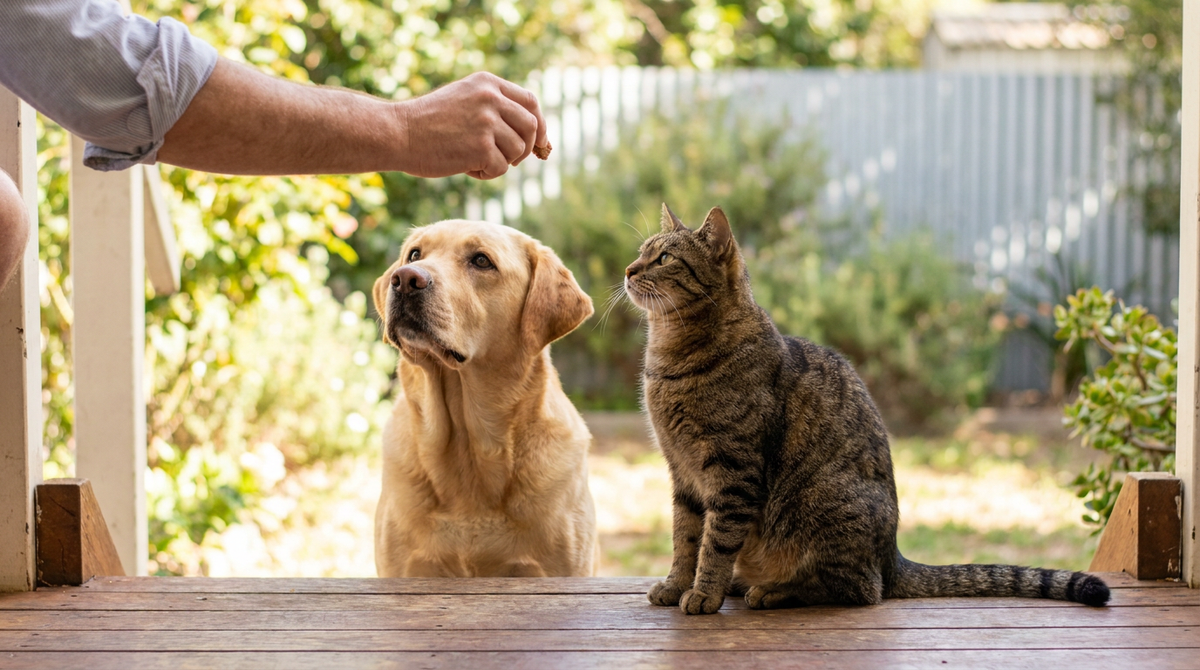
This is where most well-intentioned training quietly goes wrong. A reward has to arrive while the behaviour is happening, or within about a second of it, for your pet to connect the two. Fumble in your pocket for five seconds and your dog has already stood up, looked away and sniffed the floor. You have not rewarded the sit. You have rewarded whatever they happened to be doing when the food appeared.
The fix is a marker: a clicker, or a short consistent word such as yes. Before it means anything, you have to teach it, as the steps below show.
1. Charge the marker
Make the sound, then immediately give a treat. Repeat until your pet's head comes up at the sound alone.
2. Mark the instant
Click or say the word at the exact moment of the right behaviour.
3. Then reward
The treat can follow a couple of seconds later, because the marker has already told your pet which moment earned it.
4. Be ready
Keep rewards in a pouch or pocket, in pieces small enough to swallow in one go.
03Keep sessions short and finish while they are still keen
A few minutes at a time, several times a day, works far better than one long session at the weekend. Concentration is finite, particularly for puppies, kittens and older animals, and a session that runs past the point of enthusiasm teaches your pet that training gets boring. So stop early. Finish on something your pet can already do easily, while they still want more. That is the single most useful piece of technique in this article, and it costs nothing.
Watch for the signals that you have gone too long: sniffing the ground, wandering off, yawning, sudden interest in something across the room, or in a cat's case simply leaving. None of that is defiance. It is a full brain.
Break bigger goals into small steps and reward progress toward them rather than holding out for the finished article. If you are teaching a paw target, reward the weight shift, then the lift, then the touch. Waiting for perfection means rewarding almost nothing, and nothing is what you get back.
The easiest way to fit this in is to stop scheduling it. Ask for a sit before the lead clips on. Practise a recall across the backyard while the kettle boils. Reward your cat for walking calmly into the carrier on an ordinary afternoon, months before the next vet visit. Cats in particular do well with very short sessions just before a meal, when food is genuinely interesting to them. For more on rewards that suit frequent training, see our guide to training treats for dogs and low-fat dog treats.
04Find out what your pet actually loves
Here is a point that gets missed constantly: the value of a reward is decided by the animal, not by the packet or the price. Test it properly. Offer two options at once and see which one your pet goes for first. Repeat that a few times with different pairings and you will end up with a rough ranking, from everyday rewards up to the thing your pet would cross a room for.
Then spend that ranking deliberately. Save the highest-value reward for the hardest jobs: recall away from a distraction, tolerating nail trims, staying settled at the vet. Use ordinary rewards for easy repetitions at home. Paying top price for a sit in the kitchen leaves you nothing in reserve when it actually counts.
Aroma is a large part of value for dogs, who work far more on smell than we tend to assume. A strongly scented reward holds attention in a distracting environment in a way a bland one will not. It is one of the reasons we built Healthy Reward Bites around Australian reduced-fat cheddar, freeze-dried it, and made the cubes easy to break into pea-sized pieces.
Do not assume food wins, either. For some dogs a tug toy or a thrown ball outranks anything edible. For many cats a wand toy and a ten-second chase is the better currency. Praise and a scratch in the right spot are real rewards for plenty of animals.
Cats also earn their food differently. Puzzle feeders and food-dispensing toys let a cat forage and problem solve, which is mentally and physically engaging in a way a bowl is not. Start with something easy so they succeed, then increase the difficulty as they get the idea. Use part of the daily food allowance for it rather than adding extra on top. Our guide to healthy treats for cats has more ideas for feline rewards.
05Treats still count as food
The fun part comes with one piece of arithmetic attached, and it is the piece that keeps everything else sustainable. The widely used veterinary guideline is that treats should make up no more than about 10 per cent of your pet's daily calories, with the remaining 90 per cent coming from a complete, balanced diet. We have written that up in full in our guide to how many treats per day, including how to work it out for your own pet's weight.
The training budget
Treats: about 10 per cent of the day
On a heavy training day, the neat solution is not to train less. It is to take the training portion out of the daily meal ration rather than adding it on top. Your pet gets the same amount of food, just delivered in a far more interesting way.
Break rewards small. A pea-sized piece reinforces a behaviour exactly as well as a whole cube, because what your dog is responding to is the event of being rewarded and the aroma, not the volume. Small pieces mean more repetitions for the same calories, and more repetitions is what actually builds a behaviour. If weight is a concern, read our guide to weight management for dogs and cats.
In the treat pouch
- Small, pea-sized pieces of a reward made for dogs or cats
- Reduced-fat options for frequent rewarding
- Part of the daily meal ration on heavy training days
Keep out
- Anything sweetened with xylitol, which is toxic to dogs
- Chocolate, grapes, raisins, onion and garlic
- Unchecked human food: read the label first
See our list of ingredients to avoid in dog treats for more detail. If your pet is overweight, has a health condition, or is on a prescription diet, talk to your vet before adding treats to the routine.
Functional treats and pet supplements can do double duty here, giving you a reward that also contributes something to the diet. They are still food, though, and they still count inside that 10 per cent. That is the honest version, and it is the one worth working to. For the bigger picture, our complete Australian guide to healthy pet treats brings it together.
None of this needs a course, a schedule or any particular talent. It needs small rewards, good timing, short sessions and a bit of curiosity about what your own animal finds worth working for. The training is really just the by-product. What you are actually building is a way of communicating with each other, and most pets enjoy that a great deal more than they enjoy the cheese.
Frequently asked questions
How do I start reward-based training with an adult dog?
The same way you would with a puppy. Adult dogs learn perfectly well. Pick one behaviour, decide what you want your dog to do instead of the thing you would like to stop, get some small high-value rewards ready, and work in two-minute sessions. Reward generously at first, then gradually less often as the behaviour becomes reliable.
Can you actually train a cat?
Yes. Cats respond to the same reward-based principles as dogs, including clicker training, which has been studied in shelter cats. The differences are practical: keep sessions very short, run them before a meal when food is motivating, and accept that a cat will end the session when it has decided it is finished. Carrier training, coming when called and tolerating grooming are all realistic goals.
My dog only listens when I have food in my hand. What am I doing wrong?
Usually the food has become a cue rather than a consequence. Stop showing the treat before you ask. Give the cue with empty hands, mark the behaviour with a clicker or a word, then produce the reward afterwards. Once the behaviour is reliable, reward it intermittently rather than every time, and mix in praise, play and real-life rewards such as the door opening or the lead going on.
How many treats is too many?
The common veterinary guideline is around 10 per cent of daily calories from treats. On heavy training days, take that portion out of the daily meal ration instead of adding it on top, and break rewards into small pieces so you get more repetitions for the same calories.
What if my pet is not interested in food rewards?
First check the obvious. Are you training right after a big meal, is the environment too distracting, is the reward simply not exciting enough? Try a stronger-smelling option, or train before mealtimes. If food holds no appeal at all, use toys, play or praise instead. A sudden loss of interest in food in a pet that was previously keen is worth mentioning to your vet.
Should I use a clicker?
It helps, but any short consistent marker word works just as well. The value is in precision, not in the device. Whatever you use, pair the sound with a treat repeatedly first so that it means something, then use it to mark the exact instant your pet does the right thing.
Is it ever appropriate to tell my dog off?
Reward-based training does not rely on punishment or on asserting dominance, and the RSPCA is clear that this is both the most humane and the most effective approach. Punishment tends to suppress a behaviour without addressing why it is happening, and it can damage the relationship you are trying to build. Redirect to something you can reward instead. If a behaviour is persistent, sudden or concerning, see your vet, who can rule out a medical cause and refer you to a qualified behaviourist.

A training reward built for frequent rewarding
Freeze-dried, 100 per cent Australian reduced-fat cheddar that breaks easily into pea-sized pieces. High aroma for motivation, lower in fat so you can reward more often.
Shop Healthy Reward Bites →Human-grade · Australian-made
This article is general information and is not a substitute for veterinary advice. If you are worried about your pet, contact your vet.
Explore our range of dog and cat supplements, made in Australia with human-grade ingredients.